
In this post, I share my experiences with four antennas for 868 MHz LoRa applications. All measurements were conducted using my LiteVNA and summarized in a table with manufacturer specifications. The antennas—ZIISOR SMA-J 3.5 dBi, the SMA-Male rubber antenna often included with LilyGo and Heltec devices, the CDEBYTE TX868-BLG-26 fiberglass antenna and the Alfa 868 5acm—were tested for their performance and suitability for LoRa projects. All antennas and test equipment were purchased privately by me. First, an overview of common connector types to understand their differences and applications.

Overview of Common Connector Types #
SMA #
SMA connectors are compact screw-type connections, widely used in LoRa boards like LilyGo or Heltec. Standard SMA has a male connector with a pin and a female socket, while RP-SMA (Reverse Polarity) swaps the polarity, so male has the socket and female has the pin. SMA is robust, easy to handle and ideal for modular IoT projects where antennas need to be swapped quickly.

N-Type #
N-Type connectors are larger and more durable than SMA, perfect for outdoor applications as they can handle higher transmission power and are often weatherproof. They are the top choice for stationary LoRa gateways or professional radio installations.


IPEX #
IPEX, also known as U.FL, are tiny connectors used directly on circuit boards. They are found in compact LoRa modules or small IoT boards where space is critical. For measurements or larger antennas, an adapter to SMA or N-Type is often required.

BNC #
BNC connectors use a twist-and-snap mechanism, popular in labs and amateur radio. They are rare in modern LoRa devices but are excellent for temporary test setups or experiments.

What is SWR? #
SWR (Standing Wave Ratio) measures how well an antenna is matched to the transmission system (e.g., a LoRa board). It indicates how much of the transmitted energy is reflected. A low SWR (e.g., 1.0 to 1.5) indicates good matching and efficient energy transfer. A high SWR (e.g., above 2.0) suggests losses that reduce range and performance.
Specifications and Measurements #
The following table summarizes the specifications and my SWR measurements of the tested antennas, along with practical use recommendations.
| Property | ZIISOR SMA-J 3.5 dBi | SMA-Male Rubber Antenna (LilyGo/Heltec) | CDEBYTE TX868-BLG-26 | Alfa 868 5acm |
|---|---|---|---|---|
| Frequency Range | 868 MHz | 868 MHz (typically 860–870 MHz) | 860–940 MHz | 865–868 MHz |
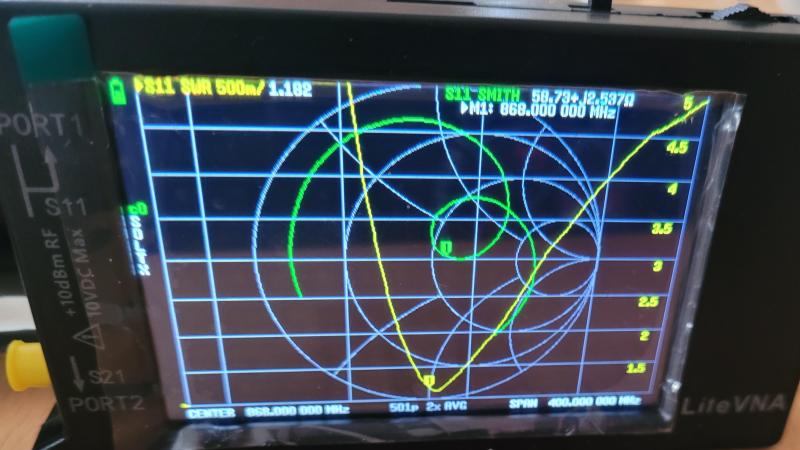
| Measured SWR | 1.370 (best SWR at 90° bend) | 1.698–2.093 | 1.236 | 1.182 |
| Gain | 3.5 dBi | 2–3 dBi (typical) | 3 dBi | 5 dBi |
| Connector | SMA-J | SMA-Male | N-Male | N-Male |
| VSWR (Manufacturer) | ≤ 1.5 | ≤ 2.0 (typical) | < 2.0 | ≤ 2.0 |
| Polarization | Vertical | Vertical/Linear | Vertical | Vertical |
| Radiation Pattern | Omnidirectional | Omnidirectional | Omnidirectional | Omnidirectional |
| Input Impedance | 50 Ω | 50 Ω | 50 Ω | 50 Ω |
| Power | 10 W / 20 W | 50 W (typical) | 100 W | Not specified |
| Height/Dimensions | 52–200 mm | Approx. 150–170 mm (typical) | 260 mm (Diameter: 20 mm) | 180 mm (Diameter: 22 mm) |
| Material | TPEE | Rubber | FRP (Fiberglass) | Not specified |
| Weight | Not specified | Light (approx. 20–30 g, typical) | 120 g | 43 g |
| Operating Temperature | -30 °C to +75 °C | -20 °C to +60 °C (typical) | Not specified | -40 °C to +85 °C |
| Operating Humidity | 5 %–95 % | 5 %–95 % (typical) | Not specified | 95 % @ 25 °C |
| Color | Black | Black | Not specified | Not specified |
| Use Case | Mobile or stationary (good all-rounder) | Mobile (not recommended) | Stationary (valleys, outdoor) | Stationary (long distances) |
My Observations #
ZIISOR SMA-J 3.5 dBi #
With an SWR of 1.370 at a 90° bend, this antenna offers solid performance and is a good all-rounder. It is suitable for both mobile and stationary setups, making it a reliable choice for hobbyists seeking a balance between range and flexibility. Its compact design and TPEE material make it robust for everyday use. Buy ZIISOR SMA-J 3.5 dBi.

ZIISOR SMA-J 3.5 dBi - SWR #

SMA-Male Rubber Antenna (LilyGo/Heltec) #
This antenna is often included with LilyGo or Heltec boards like the T-Beam or LoRa32 and is intended for mobile hobby projects. However, my SWR test (1.698–2.093) shows mediocre matching, and the quality is rather low. I recommend using it only for initial tests and replacing it with a better alternative like the ZIISOR whenever possible.

Rubber Antenna - SWR #

CDEBYTE TX868-BLG-26 #
This fiberglass antenna is a powerhouse for stationary setups, especially for applications above valleys, as its 3 dBi gain provides broad coverage. My SWR measurement of 1.236 is excellent, and the antenna is much more readily available in Germany than the Alfa 868. With robust fiberglass, it is ideal for outdoor use. Buy CDEBYTE TX868-BLG-26.

TX868-BLG-26 - SWR #

Alfa 868 5acm #
With an SWR of 1.182 and 5 dBi gain, this antenna is my favorite for stationary setups where maximum range is needed. It is perfect for long distances. The low weight (43 g) and high temperature stability are advantages, but availability in Germany is limited, which can make sourcing difficult. Alfa 868.

Alfa 868 5acm - SWR #
Conclusion #
The choice of antenna depends on your project. For versatile use, the ZIISOR SMA-J 3.5 dBi is a strong choice, combining flexibility and solid performance. The SMA-Male rubber antenna, often included with LilyGo and Heltec devices, should be avoided due to its poor quality or used only for initial experiments. For stationary setups focusing on valleys or broad coverage, the CDEBYTE TX868-BLG-26 is excellent. For maximum range in stationary applications, the Alfa 868 is unbeatable if you can source it. Test your antenna’s alignment (e.g., a 90° bend for the ZIISOR), as it can significantly improve performance!
Feel free to share your experiences with me at blog@lucabolanz.de!